|
Almond and Multicolored Pigeons at the VDT Show in
Leipzig 2025. For the 100th anniversary of the decoding of the
Stipper gene by Wriedt and Christie 1925
Almond-colored pigeons, multicolored pigeons, stippled Danish
Tumblers, and sprinkled Rollers all share the stipper factor (St),
analyzed and named by Wriedt and Christie in the 1920s. This factor
results in a sprinked plumage in many color varieties. Pigeons with
this factor first became known through the English Almond Tumbler. A
breed standard was drafted for this breed as early as 1764,
requiring the 'best yellow' as the base color. The current German
breed standard calls for almond yellow with splashes distributed
across the entire body. Early illustrations, including those by
Eaton in 1851 and Fulton in 1876, popularized the breed and
coloration and also depicted the secondary colors used in breeding.
The sex-linked dominant inheritance was deciphered by the Norwegians
Wriedt and Christie (1925) during the analysis of Danish Stippers,
which had acquired the St-gene more than 150 years ago through
crossbreeding with English Almond Tumblers.
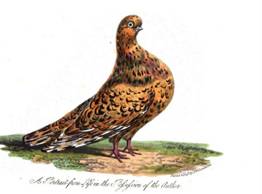 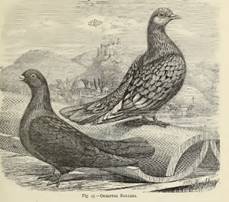
Almond-Tumbler at Eaton 1851, Oriental Roller at Fulton 1876
Around 1870, Oriental Rollers also arrived in Europe from Asia.
Fulton depicted them in black and white with the explanation that
some of them had a similar, but not identical, coloration to that of
the Short-Faced Almond Tumblers. On the continent, and initially
also in the USA, they were described as 'multicolored'.
Several collections of multicolored pigeons at the VDT show in
Leipzig in 2025 demonstrated why, in addition to the 'Almond' color
variety, the 'multicolored' variety exists not only in Oriental
Rollers. The description of the Almond coloration, which is based on
the historical standard for almond-colored Short-Beaked Tumblers,
seems too restrictive for breeders of other breeds and unnecessarily
limits the range of variation desired and utilized by many breeders.
At
the Leipzig show, complementary colors such as Red Agate and Kite
were displayed alongside Almonds in the English Short-Faced Tumbler
section.
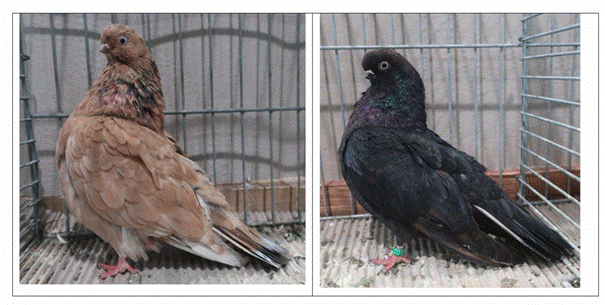
English Short Faced young cock almond and English Short Faced young
hen as one of the complementary colors
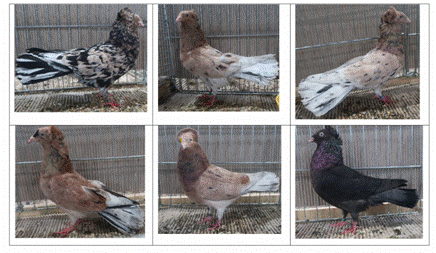
The Oriental Rollers had a wide range of color variations.
Almond-colored birds meet the criteria for multicolored birds, but
most multicolored birds do not conform to the almond coloration. A
white base color with black sprinkles results in black sprinkled
birds as a color class. These occasionally have a reddish tint in
the neck area, but this does not make them multicolored.

Oriental Rollers, multicolored and one black
sprinkled, at the VDT show Leipzig 2025
The complementary color 'Kite' was also exhibited besides the
multicolored Danzig Highflyers. Multicolored birds are a relatively
new color variety within this breed, developed in recent decades.
Danzig Highflyers in multicolored plumage and a kite as a
complementary color at the VDT show in Leipzig 2025
One of the Dutch Highflyers in the AOC class with the typical
coloring of multicolored birds, another without any speckling in the
neck area. Some guidelines of the standard should also be observed
with multicolored birds.

Dutch Highflyer multicolored at the VDT-Show Leipzig 2025
No
rose without thorns! The best 'yellow' required in the Standard of
1764 can only be achieved with the help of the dilution factor. This
causes problems in purebred breeding. As early as 1876, Fulton knew
that when two Almonds were paired, vitality problems would arise in
the offspring of homozygous males. With their predominantly white
plumage, they also failed to meet the color requirements for either
Almonds or multicolored birds. Some of these white birds were
suitable for breeding, but upon closer inspection, they showed
problems with motoric and free flight. Therefore, like Eaton before
him, Fulton also provided a detailed description of the
complementary colors used in breeding. These are primarily Kites and
Agates. The use of complementary colors in breeding is now required
in breeding guidelines for animal welfare reasons. Two carriers of
the Stipper gene must not be paired together because this can
produce, among others, homozygous young males with defects. This
does not occur when multicolored and Almonds are paired with their
respective secondary colors.
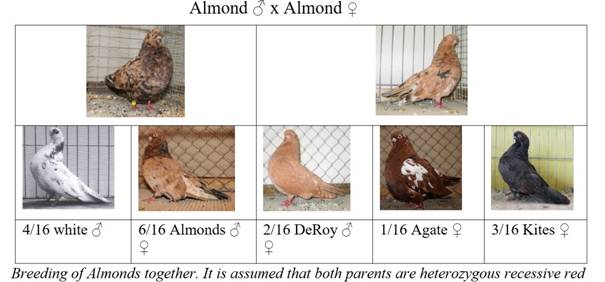
Source: Sell, A., and J. Sell, Genetics of the Domestic Pigeon,
Achim 2025
On
social media, it is occasionally announced with evident pride that,
contrary to popular expectation, the mating of two multicolored
pigeons has also produced healthy male offspring. The authors of
such statements have misunderstood something. Not all, but half of
the young males will have defects or die before hatching. This is
sufficient grounds for classifying the breeding practices as
detrimental to health. Some of reports of successfully raising
homozygous males are likely cases of mistaken identity. For example,
with the Faded allele, an allele of the Stipper gene, homozygous
young males are healthy and can be mistaken for stippers and
black-sprinkled pigeons in appearance. In any case, such reports
create the impression that breeding guidelines in fancy pigeon
breeding are insufficiently communicated and that many pigeon
fanciers lack basic genetic knowledge. This can have negative
repercussions for the entire pigeon breeding fancy.
Literature:
Eaton, J.M., A
Treatise on the Art of Breeding and Managing the Almond Tumbler,
Published for the Author, London 1851
Fulton, R., The
Illustrated Book of Pigeons, London et al. 1876
Sell, A., and Jana
Sell, Genetic of the Domestic Pigeon, Achim 2025
Wriedt, W., und W.
Christie, Zur Genetik der gesprenkelten Haustaube. Zeitschrift für
induktive Abstammungs- und Vererbungslehre 38 (1925), 271-306.
|
