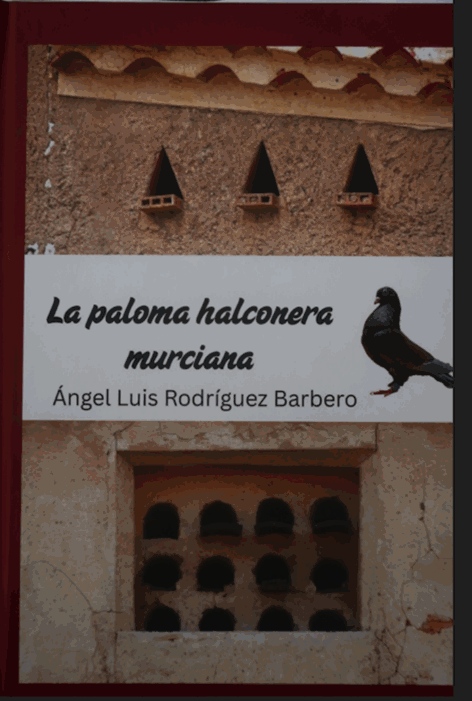
Angel Luis Rodriguez Barbero, La paloma halconera
murciana (The Murcian Falcon Pigeon), Madrid 2026, 68 pages, likely
available only through the author
The book by Angel Luis Rodriguez Barbero is a
beautifully designed work about a pigeon breed that has existed for
a long time but never received official recognition. Consequently,
the breed was never integrated into the exhibition circuit—and,
unsurprisingly, it is absent in contemporary books on pigeons. This
is typical for old breeds in other countries as well; for instance,
in Germany, this applies to the Viennese Racing Pigeons, Flying
Calottes, and Copenhagen Magpie —breeds that were once more commonly
found in Hamburg. Like the Pomeranian Blue Magpie Tumbler —which
also lacks an official standard—and that like the Copenhagen Magpie
is still used today by breeders of short-beaked pigeons as a foster
parent breed.
In such cases, sources consist of oral traditions,
family chronicles, regional historical accounts of the land and its
people—including their leisure activities—informal communications
and newsletters from clubs, and occasional passing mentions in
magazine articles. In the case of the Falcon Pigeon, the primary
source is oral transmission, supplemented by historical information
regarding pigeon breeding in the Murcia region.
The text describes how the author and his associates
collected the remaining specimens of a nearly extinct breed,
stimulated interest in it, promoted it internationally, and worked
toward its official recognition.
Murcia is a city in southeastern Spain and the
capital of the region of the same name. By the end of Muslim rule in
the 13th century, the region already possessed a rich culture
surrounding pigeons. Pigeons were valued not only for their
droppings—which were useful for agriculture—but also for their
intrinsic, symbolic worth. According to an account based on
historical sources, Ibn Hud, the last Moorish king of Murcia,
maintained a famous dovecote in Aljucer. This enthusiasm for pigeons
in Murcia led, at an early stage, to the establishment of numerous
regulations, which are recorded in documents from that period
(Manuel Gea Rovira, Notas de la cultura colombófila muriciana,
Palomo Deportivos, March 1970, pp. 28–29).
The origins of many Spanish pigeon breeds are traced
back to this era, with the route via North Africa cited as the path
of their arrival. This also applies to the Tumbler pigeons found in
the region and on the nearby Balearic Islands—a category that
includes the Murcian falcon pigeon.
Antonio Ortuno Navarro provides an account of pigeon
sports in the port city of Cartagena—the second-largest city in the
Murcia region—as they existed in the 1930s. In addition to the
practice of using "thief pigeons", Navarro describes three types of
flying pigeons: Tenados, Escampadissos, and Trepados. The Tenados
were likely pigeons that did not stray far from their loft. It is
said that Escampadissos—even today—respond to attacks by birds of
prey by flying around or toward the predator, or by ascending to a
higher altitude, thereby disorienting the attacker. This behavior
aligns with the traits attributed to the "Murcian falcon-pigeon" (as
the name implies). Trepados were presumably high-flying pigeons
characterized by a rapid, "climbing" ascent. Regarding these flying
pigeons, Navarro writes: "The spectacle they offered upon release
was extraordinary: their rapid ascents, the subsequent duels with
falcons—which the pigeons would disorient during the attacks—and the
gunshots fired by the owners to drive the falcons away" (Ahondando
en mis recuerdos, Palomas Deportivas, March 1973).
Efforts to locate remnants of this breed proved
successful, primarily on Mallorca, where a small population had been
saved from extinction. This group became the foundation for the
breed's preservation. The birds were predominantly recessive red,
carrying the "pale" dilution factor—referred to as "cinnamon-colored"
on page 33. Some of these individuals exhibited white spotting. The
book also features a dominant red specimen that carries the "pale"
factor (described as "gold").
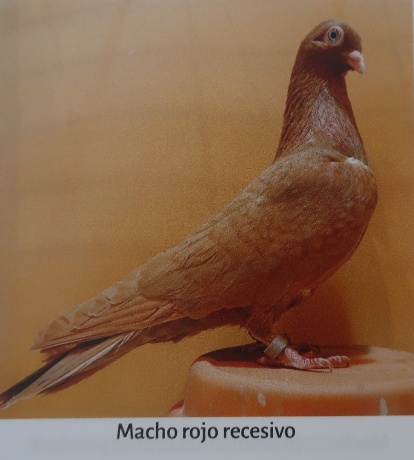
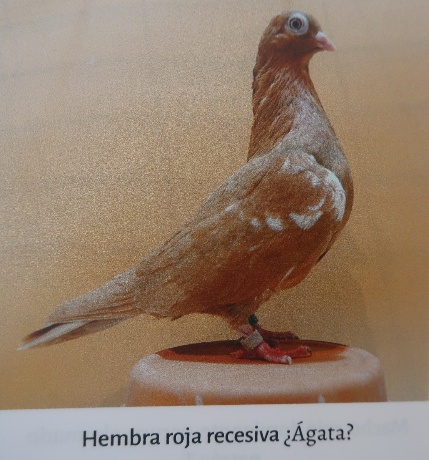
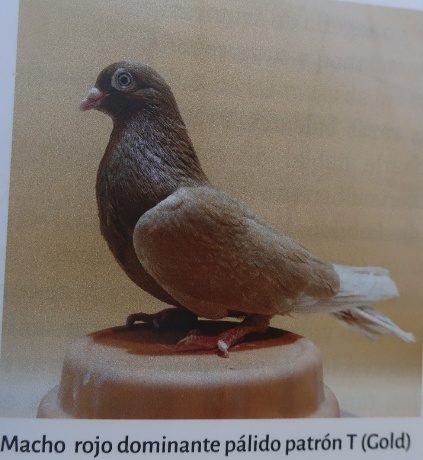
Source: Murcian Falcon Pigeon from the reviewed
book
The presence of the "stipper" factor within the
breed is a result of the crossbreeding necessary to avoid overly
close inbreeding. This can be seen in the book, where an animal is
depicted as a "DeRoy." The text describes crosses with Portuguese
and Catalan Tumblers, as well as with the Alicantino flying pigeon.
The implications of these crosses for flight
performance are not specified. If the performance of a given flock
has suffered, it may need to be revitalized through further crossing
with suitable breeds. Based on descriptions of flight behavior in
the literature—and despite external differences, such as a broader
tail with more than 12 feathers—the Escampadissa would be a
candidate for this, provided that lines capable of flight still
exist within that breed. Another option, closer in type to the
established phenotype, is the Pinto Tumbler. Both are flying pigeon
breeds from Mallorca that were showcased by the Asoc. Avira, Illes
Balears at a European exhibition 2006.
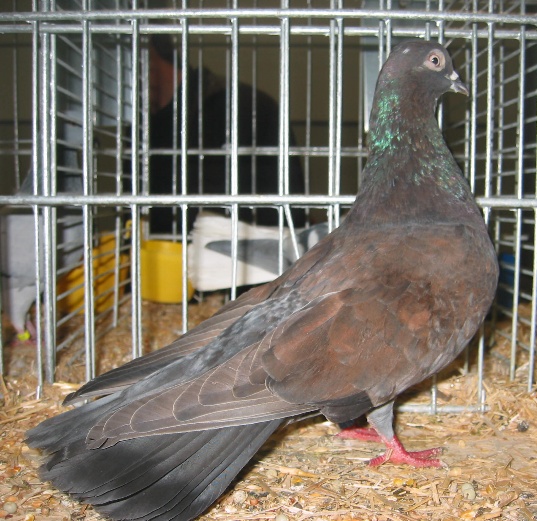
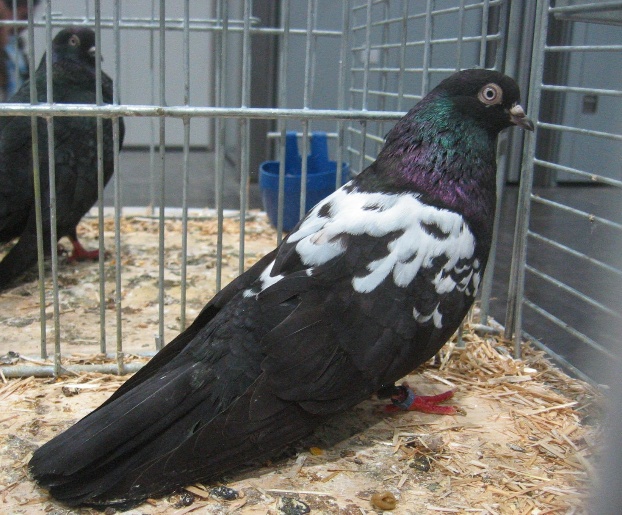
Escampadissa Tumbler and Pinta Tümmler at
exhibited at the 25th EE Anniversary European Exhibition 2006 in
Leipzig, shown by the Asoc. Aviram Illes Balears, Spanien (Fotos:
Sell)
According to the description, the Murcian Falcon
Pigeon is a small-to-medium-sized tumbler (240–270 g) with a
horizontal stance, a medium-length beak (1.8–2 cm), and a tail
consisting of 12 feathers. The wings are carried above the tail. In
terms of appearance, it possesses the characteristics required for
both a capable flying pigeon and a suitable exhibition breed. This
book is valuable not only for bringing Spanish high-flying pigeons
into the spotlight, but also for highlighting the challenges
involved in preserving a rare breed. Furthermore, the sections of
the book that share experiences regarding crossbreeding with related
varieties will undoubtedly prove instructive for many readers.