|
Genetics of the Domestic Pigeon 2025
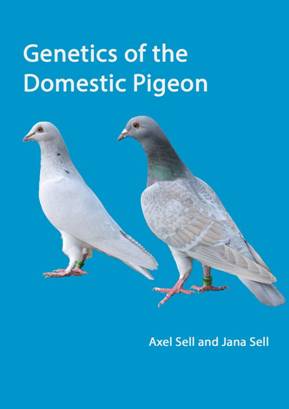
In the book "Genetics of the Domestic Pigeon" the inheritance
mechanisms important for breeders are illustrated using the
well-known basic color varieties of the domestic pigeon. Anyone who
understands the combinatorial interplay of hereditary factors can
easily predict what to expect when mating different color varieties,
and also what cannot be expected under any circumstances. Then,
crossbreeding color varieties is no longer a gamble. With the
general decline in numbers of breeders of fancy pigeons, such
crosses are necessary not only to improve individual color varieties
but also to avoid overly close inbreeding. The hereditary mechanisms
shown as examples for the basic color variations also serve as an
explanatory model for other colorations documented in many
illustrations.
Knowledge of color genetics is also beneficial for racing pigeon
breeders when it comes to recognizing traditional but rare racing
pigeon colors and maintaining high-performing rare colored birds
within their flocks. In some cases, knowledge of color genetics also
allows for a critical examination of pedigrees.
The hereditary mechanisms mediated by color genetics, such as
dominance, recessiveness, intermediate and sex-linked inheritance,
correlations, linkages, etc., can also be applied to explaining
feather structures, shapes, and size effects. While these traits are
primarily relevant for fancy pigeons, lethal and semi-lethal
effects, hereditary diseases, and inbreeding depression affect both
sections.
This also applies to performance traits. In both commercial pigeon
breeding and racing pigeon breeding, molecular genetic methods are
increasingly used to identify performance-enhancing genes. This will
also play an increasingly important role in practice.
Molecular genetic analyses are also used to analyze the origin and
relationships of breeds. Statements in these reports sometimes
contradict well-documented facts and are not supported by the data
presented in the studies themselves. The digitization of library
holdings and image archives, and improved access to information, are
contributing to the need to revise some common assumptions and even
pedigrees of breeds.
Axel Sell and Jana Sell, Genetics of the Domestic Pigeon. 192 pages,
350 figures. Sell publishing, Achim 2025, Verlag Karin und A. Sell,
Potsdamer Str. 23, 28832 Achim,
www.taubensell.de.
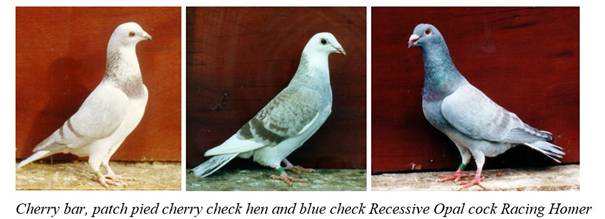
Rare Racing Homer Colors: Cherry and Recessive Opal
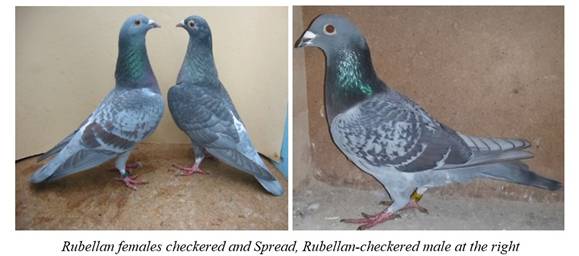
Rare Racing Homer Colors: Spread and Non-Spread Rubellan, named
after the brownish/reddish mineral rubellan
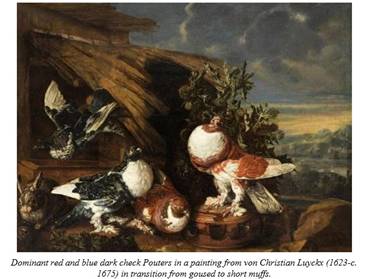
Grouse at blue dark check and dominant red pouters still in the 17th
century
|
