|
Historically Significant Pigeon Breeds: Moscow Grey Tumblers
Origins and Appearance
A brochure on Russian
pigeon breeds—published in Moscow in 1992 by the editorial staff of
the magazine ‘RURAL NOV’ pays tribute to the Moscow Grey Tumbler, a
breed that originated in Moscow in the early 19th century. Having
become completely or nearly extinct following the wars, attempts
were made to revive the breed. It originally emerged from crossing
Moscow Tumblers with Orloff Tumblers—specifically, according to this
source, with both white and red varieties. It is remembered as a
pigeon of enchanting beauty: elongated and well-proportioned, with a
low-slung carriage. The wing butts of the long flight feathers
project close to the breast, the breast is thrust proudly forward
and the neck is long and majestically curved.
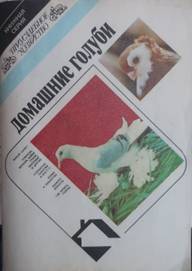 
Pigeon Breeds 1992 and Pigeon
Breeding 1987
The head is high-browed and
cube-shaped. The eyes are large, expressively prominent, and dark
silver, with broad eye-ceres. The beak has a broad base, is short
and strong, and points downwards. The white or ash-colored tail is
slightly raised. At least the five outer flight feathers are
supposed to be white—though this is evidently not the case with the
bird pictured.
The five white
flight feathers also mentioned by Romanov/Razbesov (1987), though a
self is shown here as well.
However, the first photo clearly
shows the broad rump mentioned by Dürigen (1923) in an early German
description. Beak open: According to Dürigen, the upper and lower
mandibles should touch only at the tip (p. 500). According to RURAL
NOV (p. 13), the term ‘gray’ is misleading; the plumage can be red,
cast-iron colored, or brick-red in various shades.
Ultimately, the
pigeons became too valuable for free-flying; only veterans would
still remember their magnificent flying feats.
Genetic classification of the coloration
In
his 1971 ‘Handbuch der Taubenrassen’ (Handbook of Pigeon Breeds),
Joachim Schütte distinguishes between "grey-reds" and "greys" as
variants. Genetically, the first group consists of Dominant Reds
with a dark check pattern like the pigeon from RURAL NOV. The "greys"
are also Dominant Reds that additionally carry the "Spread" factor
(either homozygous or heterozygous); their coloration varies due to
modifying factors. From a breeding perspective, these variants can
be paired with one another without difficulty.
The pigeon in the
picture by Romanov and Razbesov is difficult to classify; it looks
more like a dominant red Stipper cock.
According to Schütte (p.
262), the "greys" reportedly had a light tail bar—or, more
precisely, some certainly exhibited a lightening in the tail-bar
area, a feature found in many Dominant Reds. This is not a
lightening to white, however, as seen in Star-tailed Tumblers.
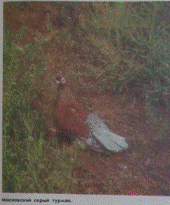 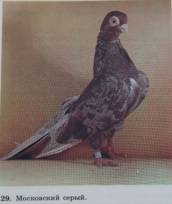
How varied memories of
pigeon breeds that have since gone extinct can be! (RURAL NOV 1992
and Romanov/Razbesov 1987)
Recreating the breed from
related breeds
According to literature,
Moscow Greys—or at least birds resembling that phenotype—were
historically created by crossing Tula Star-tailed Tumblers (Dominant
Red) with self-colored Tumblers. A black cock paired with a red Tula
hen will produce "Greys." A dark-checkered cock paired with a Tula
hen will produce "Grey-Reds." If the black cock is heterozygous for
the Spread factor, the offspring will include both "Greys" and
"Grey-Reds."
Crossing of Tula Tumblers
with black magpie-marked Moscow Tumblers is another viable option.
Insights into the inheritance of this magpie pattern are available
from own studies on red Volga Tumblers, which possess a similar
magpie marking (Sell 2012). Initial pairings with self-colored birds
yield birds with a few white flight feathers. Through selection, it
is possible to develop birds with the correct white outer primaries
or flight feathers from that stock. Segregation in the F2
produces magpie-marked birds alongside white-flighted birds, birds
with unregular white flights, some beards-marked and self-colored
birds.
However, the optimism
expressed by the authors of the 1992 ‘RURAL NOWS’ report—that the
birds' flying ability would be restored along with the
phenotype—seems rather doubtful given today's conditions for keeping
flying pigeons.
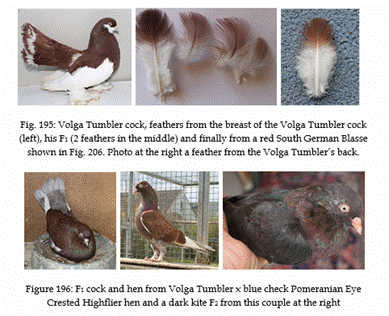 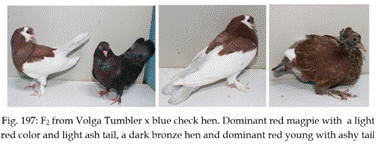
Volga Tumbler cross: two
first-generation young birds from the pairing with a blue-checkered
hen, and selected F2 young birds.
Source:
Sell, Pigeon Genetics 2012
Caution regarding the
‘Lebanon Bronze’
Like Lebanon Pigeons,
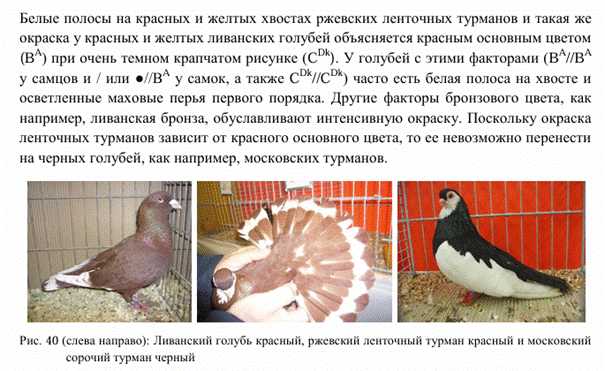
Volga Tumblers possess solid red plumage. Apart from the white tail
band, the tail is also deep red. This contradicts the description of
the historical Moscow Greys and Moscow Grey-Reds, which featured
ash-colored tails and flight feathers. Here, too, selection aimed at
the desired breeding goal is necessary.
Literature:
Dürigen, Bruno, Die
Geflügelzucht [Poultry Breeding], 4th and 5th revised editions, Vol.
1: Species and Breeds, Berlin 1923
Romanov, V.A., O.K. Razbesov,
Taubenzucht (russisch), Moskau, Agropromizdat 1987
RURAL NOV (Ed.), Russian,
[Appendix: Household – Agriculture, Domestic Pigeons – Pigeon
Breeds], Moscow 1992
Schütte, Joachim, Handbuch
der Taubenrassen [Handbook of Pigeon Breeds], Melsungen et al. 1971
Sell, Axel, Pigeon
Genetics: Applied Genetics in the Domestic Pigeon, Achim 2012
Sell, Axel, Генетика голубей
Введение в практическую генетику домашних голубей д.э.н., профессор
Аксель Зелль (Genetics of the Pigeon, russian language), Achim 2011,
www.taubensell.de
|
