|
The History of the Ancient
Messenger Pigeon: A picture is worth a thousand words
Lifelike images from the
past often convey far more than a thousand words. Sometimes, they
even refute accounts written by later observers. Common perceptions
are frequently shaped by flights of fancy and gaps in knowledge
filled by speculation—misconceptions that persist to this day. This
holds true for the history of the ancient messenger pigeon as well,
despite corrections subsequently offered by critical authors.
The "Carrier" pigeon of the
Ottoman Empire, described by Willughby in 1678, could be seen in
London—notably in the royal flight aviaries (p. 181). It likely
arrived there from Scanderoon in Asia Minor. The Royal Navy visited
this port every few years due to the presence of an English merchant
settlement in Aleppo, located about 100 km inland. The merchants
regularly used messenger pigeons to receive news of arriving ships
(as recorded by Henry Teonge in his diary from 1675–1679).
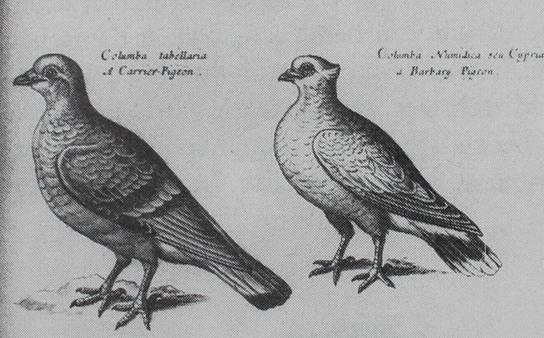
Source: Willughby 1678
According to Willughby’s
description, the Carrier was the size of an ordinary pigeon, or
slightly smaller; its coloration is dark blue or blackish, and the
eye is surrounded by bare, knobby, white, fleshy skin. The beak is
black—not short, but of moderate length. Halfway from the head the
upper chap of the bill is covered with a double crust of white naked
fungous skin, of the same type as the broad circle encompassing the
eyes. The size shown in the illustration resemble those of the
adjacent Barbary Pigeon; they are visible but far less pronounced
than those of the Carrier described by Moore in 1735 and depicted
in the ‘Treatise’ of 1765.
Throughout his life, the
bibliographer Werner K.G. Moebes (1899–1983) grappled with the
question of the relationships between the English Carrier, the
Dragoon, and the Horseman—breeds that Moore, as the author of the
first monograph on domestic pigeons, linked to messenger pigeons in
his 1735 text. Moebes’s efforts proved fruitless, partly because
Moore had interpreted Willughby’s accounts idiosyncratically and
laid false trails.
He attributed the legend of
the ancient messenger pigeon to the pigeon—already bred within his
circle of friends for size, beak length, and extreme wattling.
For Willughby, "Horseman"
was synonymous with "Carrier," as the "Light Horseman" (an allusion
to light cavalry) is described as a cross between a Carrier and a
Pouter. Moore, by contrast, portrays the Horseman as a version of
the Carrier in which all the Carrier’s characteristic traits are
less pronounced. He notes that the "true" Carrier was simply too
valuable in his day to risk their being lost (p. 32)—hence the use
of the Horseman as a messenger pigeon in England. He questions
whether the Horseman constitutes a distinct breed, even though he
was aware of imports of such pigeons from Scanderoon and knew of
their capabilities. He stops himself from dwelling on the matter
further, deeming it not his place to answer such weighty questions
(Moore 1735, p. 31).
Even early dissenting voices
in the literature failed to shake the myth—originated by Moore—that
the English Exhibition Carrier was an ancient messenger pigeon. Had
Selby (1835), Tegetmeier (1868), and Fulton (1876) possessed the
images of Dragoons, Horsemans, and Carriers from the period shortly
after Moore—images now accessible thanks to the digitization of
library collections—to substantiate their doubts, they might have
received a more attentive hearing. As it stands, early fanciful
notions continue to shape the perceptions of many pigeon enthusiasts
to this day.
Based on the depictions of
the Dragoon and Horseman by Peter Paillou (1744/45) and the English
Carrier by Ch. Collins (1741), the former appear to be distinct
strains of the Arabian messenger pigeon. The English Carrier, by
contrast, is the product of selective breeding for wattle
development and crossing with upright, long-beaked Bagdettes. Brent
(1871) had already surmised as much. A drawing by Peter Paillou from
1745, included here, also points to this conclusion; while the
original is labeled "Bagdad" on the reverse, it is archived in the
collection as a "Horseman"—apparently because it did not align with
the archivist's understanding.
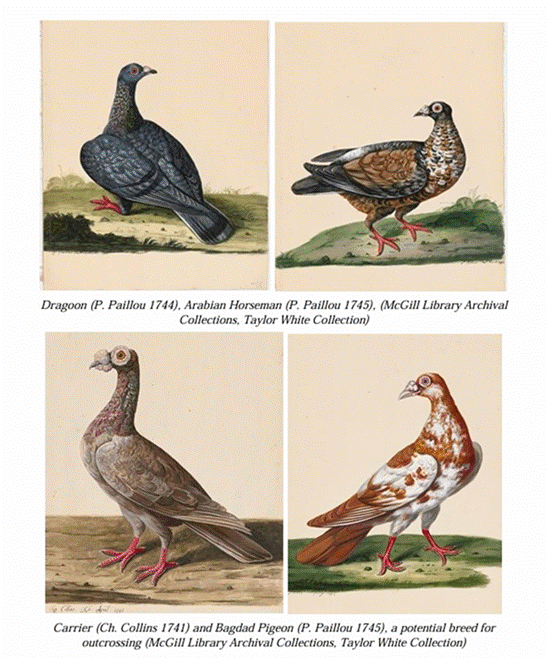
Source: Axel Sell/Jana Sell, Genetics
of the Domestic Pigeon, Achim 2025, p. 174
Literature
Anonymous, A Treatise on
Domestic Pigeons, London MDCCLXV (1765), Reprint Chicheley,
Buckinghamshire 1972.
Brent,
B.P., The Pigeon Book, 3. ed., London (1871)
Fulton, R., The
Illustrated Book of Pigeons. London, Paris, New York and Melbourne
1876.
McGill
Library Archival Collections, Taylor White Collection
Moebes,
Werner K.G., Bibliographie der Tauben, Akademischer Verlag Halle
1945
Moore, J., Pigeon-House.
Being an Introduction to Natural History of Tame Pigeons.
Columbarium: or the pigeon house, Printed for J. Wilford, London
1735.
Selby, P.J., The
Naturalist’s Library, edited by Sir W. Jardine, Bart., Vol. XIX.
Ornithology. Pigeons,
Edinburgh 1835
Sell,
Axel, Jana Sell, Genetics of the Domestic Pigeon, Achim 2025
Tegetmeier, W.B.,
Pigeons: their structure, varieties, habits and management, London
1868.
Teonge,
Henry; The Diary of Henry Teonge. Chaplain on Board H.M.‘s Ships
Assistance, Bristol, and Royal Oak, 1675-1679, edited by Sir E.
Denison Ross and Eileen Power in the Broadway Travellers. First
published in this Series 1927
Willughby,
F., Ornithologia,
compiled and edited posthumously by John Ray, London 1678
|
